
continuity, growth and trust
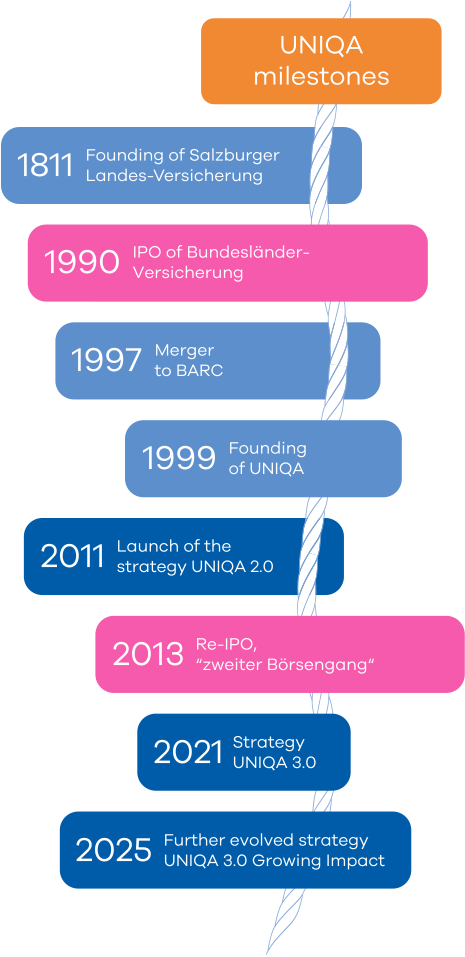
The IPO of the former Bundesländer-Versicherung in December 1990 marked the beginning of a new phase in the evolution of the UNIQA Insurance Group as it stands today. The flotation took place during a time of structural change in the Austrian insurance industry. This decision proved to be groundbreaking. The capital market opened up new scope for action, promoted more professional governance and risk management and made long-term strategic developments possible.
As a result, the capital market became a decisive factor in our corporate strategy – initially to strengthen our equity base and later as a catalyst for internationalisation, growth and increased levels of professionalism. CEO Andreas Brandstetter: “For more than 200 years, we have been protecting what matters most to people. We have been listed on the Vienna Stock Exchange for 35 years, and our expansion into Eastern Europe began around 25 years ago. Today, almost 18 million customers place their trust in us.”
Merger, new brand and expansion
The end of the 1990s saw a strategic turning point with the merger of several insurance companies and the launch of the UNIQA brand. A complex multi-brand structure was transformed into an umbrella brand that rapidly evolved to become Austria’s best-known insurance brand. The single-brand strategy proved to be a decisive competitive advantage both nationally and internationally.
Expansion into Central and Eastern Europe began in the early 2000s. UNIQA focused on organic growth and targeted acquisitions in an economic area with around 150 million inhabitants. Seven new markets were developed between 2005 and 2008. The capital market facilitated this development by providing scope for financing, and at the same time increased the requirements related to governance, reporting and risk management.
Change of course and strategic focus
The financial crisis of 2007/2008 posed fundamental challenges for UNIQA as well, resulting in greater emphasis being placed on financial strength, risk management and sustainability. Our company underwent a strategic reorganisation from 2011, which involved a sharpened focus on the core business in Austria and CEE, divestments in Western Europe, increased profitability and a clear growth agenda.
A key milestone on this path was the re-IPO in 2013, which we deliberately positioned as a “second public offering”. The free float rose to around 35 per cent and the issue price was €8 per share. Employees were selectively involved in the process. This brought the capital market even more sharply into focus from a governance perspective. “The consistent focus on the capital market was not only a financial transformation, but also a cultural one,” underlined Kurt Svoboda, Chief Financial and Risk Officer (CFO/CRO).
Growth, customers and earnings quality
UNIQA currently serves more than 18 million customers, with around 14 million of these in Central and Eastern Europe and just under 4 million in Austria. We are one of the insurance companies with the highest margins in the CEE region. We have more than doubled our number of customers since 2011, while stabilising our capital base and increasing our operational efficiency. Integration of the former AXA companies in Poland, Czechia and Slovakia was an important milestone on this journey.
UNIQA shares have been included in the ATX consistently for more than ten years and have also been included in the ATX Top Dividend since 2022. Following the presentation of the new “UNIQA 3.0 – Growing Impact” strategy for the 2025–2028 period, the share price rose steadily and stood at €15.46 at the end of 2025. The free float of 35.6 per cent corresponds to a value of €1.7 billion.
Progressive dividend strategy
UNIQA is clearly positioned as a dividend stock with growth prospects. We distributed a dividend of €0.60 per share for the 2024 financial year, with the total amounting to €184 million. Our proposed dividend for 2025 is €0.72 per share or €221 million in total. Assuming that this is approved by the Annual General Meeting, the dividend yield will be around 6 per cent. We remain committed to a progressive dividend strategy with a payout ratio of 50–60 per cent. This highlights our commitment to giving our shareholders a sustainable share in the company’s success while holding sufficient funds for investment and growth.
Profitability, efficiency and impact
With “UNIQA 3.0 – Growing Impact”, we are focusing on a strategy that is clearly geared towards the capital market. We even raised most of our growth and profitability targets in November 2025 thanks to the successful implementation of this strategy, with UNIQA aiming for average premium growth of around 6 per cent per year by 2028 and annual growth in earnings per share of at least 7 per cent. The target return on equity is expected to be over 13 per cent and the combined ratio (net) below 93 per cent. In addition to this, we also want to reduce the administrative cost ratio to below 15 per cent while keeping our solvency ratio in the range from 180 to 230 per cent.
“The capital market has shown that it considers our targets to be credible ones,” said Andreas Brandstetter, CEO of the UNIQA Insurance Group. “The trust placed in us by investors is both a confirmation and an incentive – and at the same time an obligation for the future.”
Capital market as a long-term benchmark
UNIQA’s 35 years on the stock exchange represent continuity and an ability to adapt. The capital market was and is not only a source of financing, but also a benchmark for transparency, management quality and sustainable value creation. The combination of more than 200 years of insurance tradition with capital market-oriented corporate governance lays the foundations for the next phase of growth. Or as CFO/CRO Kurt Svoboda puts it: the IPO “gave UNIQA stability and paved the way for long-term growth”.